
Organic Gardening in California
An organic lawn is safe for the pets and kids. Organic lawn care really doesn't mean a lot more work. A lawn is a wonderful place to sink your toes into, or to sit upon on a sunny day. It is a great groundcover to walk upon. But in our dry climate some consideration should be taken as to how much lawn you should have and what kind of grass is appropriate. A bluegrass or fescue lawn will actually add carbon to the atmosphere when you account for all of the energy used, including irrigation, fertilization and mowing.
Choosing the right kind of grass for your climate, exposure, and water availability will make organic lawn care much easier. Choosing the wrong kind will make the effort expensive if not futile.
I keep the lawn area limited to the amount required for walking, sitting or small children and dogs. Lawns just take too much work and resources to cover the whole yard with them. The only gardening areas that requires more labor per square foot than a lawn is a perennial bed or a pond. I like flowers so keeping the lawn sized to the amount that I need to play with the dogs and kids works great for me. For my own lawn I want to be able to mow the lawn in 15 minutes or less. That fits perfectly into the weekend sports viewing schedule, the mowing is done before halftime is over.
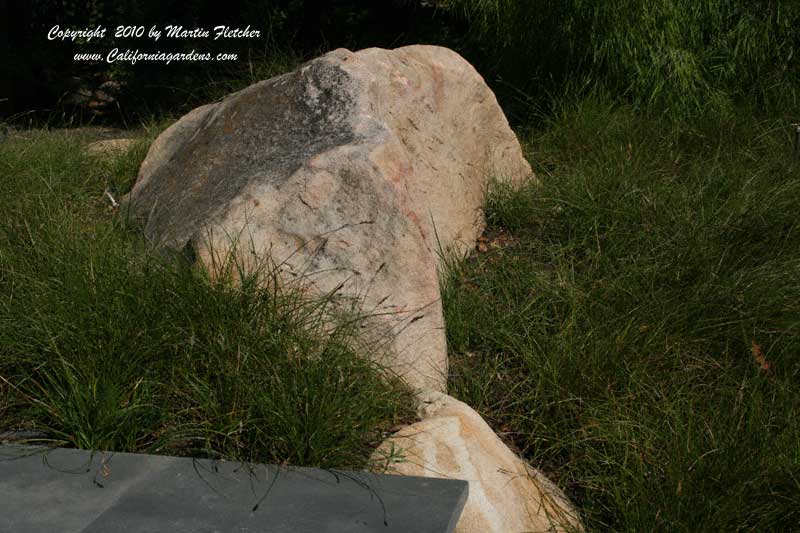
Growing a lawn in the shade is almost impossible with a traditional lawn grass. Grass requires 60% of the day to be sunny or the grass just gets too thin to call a lawn. Folks often think a spot has far more sun than it really does. It is also important to look at how far the shadow of the house is cast during the winter. The north side of the house will shade out a lot more of the yard in December than it does in June. Perennial ryegrass, St Augustine are have better tolerance for the shade. Folks are experimenting with Melica, Stipa, Festuca, Deschampsia and other bunchgrasses for a California native solution to the suburban lawn. Carex looks like a grass, and can be mowed like a grass. Carex praegracilis and Carex tumulicola are native to Southern California. Carex tumicola grows in clumps. Carex praegracilis spreads. I usually plant these as no-mow lawns. It is lush and green and you can walk or play on it. The Plants are durable and won't show wear unless there is a lot of traffic
There are grasses such as buffalo grass, creeping red fescue or Korean grass that don't require mowing. Carex tumulicola or Carex praegracilis are not true grasses but will require a third the resources of a grass lawn. If all you want is lush and green and able to be walked on this could be the answer. Buffalo grass doesn't require much water either.The Buffalo grass and Creeping Red Fescue are usually planted by seed, Korean grass with plugs. The Carex are new enough in the trade that they are often only available as gallon plants, though several growers have started putting out the plants in smaller containers. Regardless the gallon plants are readily divided to make more. The native yarrow, Achillea millefolium, has been used frequently as a lawn substitute. They come in lots of colors, but the seed is usually cheapest for the white one.
For a mowed grass lawn, Saint Augustine or Tall Fescue are probably best. Blue grass and bermuda require too many resources to look good and the bermuda escapes and is hard to remove. In an area that gets significant frost Saint Augustine turns brown for the winter. St Augustine will tolerate more shade than any other mowed grass, except the Carex praegracilis.
Irrigation is crucial in our dry climate. It is important to have a properly designed sprinkler system so that the water will be evenly distributed. Otherwise we waste a lot of water trying to keep those brown spots green. I find that an irrigation timer helps tremendously. Since I am forever forgetting to turn off the water due to life's numerous distractions. I match the water that I use with the health of the lawn. I watch to see when the grass starts to go flat or lose it's sheen. Too much water and fungal diseases start to crop up. Several newer smart timers moderate the irrigation times based on weather data pulled from the internet or from built in temperature and humidity sensors.
The height that we set our lawn mowers will effect how much water the lawn uses and loses to evaporation. I generally set my mower much higher than the average. In the end the top of the lawn is level and it looks pretty much the same. For cool season grasses such as a tall fescue I set the mower blade 4" above the ground. On my mower that is the highest setting. The more evaporation that takes place the more salt will build up in the soil.You can't tell to look at it, unless you look at your feet, because the top of the grass is all even regardless of the mower setting.
Choosing plants appropriate for our climate is probably one of the ways that you can make the greatest impact in allowing a garden to be cared for organically. More plants die due to over-watering than drought, ask any professional gardener. When a city ordinance required that the irrigation water be turned off during a severe drought in our area some years ago most of the plants that I was caring for did not all die. In fact, I was surprised that many started to grow much better. Happy plants are resistant to bug problems. For years people have been selecting plants that are equipped to handle the vagaries of our climate. The problem is that, as a group, we just don't know enough about the plants in our gardens. To remedy this problem we are developing a series of lists, pictures and descriptions detailing the needs of our plants. I spent a long time not being able to distinguish the difference between a Privet and an Indian Hawthorn. I hope the garden images on our site will help you figure out what is growing in your yard. Or maybe we can inspire you in choosing some new plants that you would like to grow as you start gardening organically.
It is particularly important with cool season grasses like Fescue that they be cut at the tallest setting as this gives them a competitive advantage against Kikuyu and Bermuda grass and other weeds. These grasses will invade eventually but the inevitable will be postponed significantly by the higher mower setting. The taller grass will shade the ground making seed germination of the weedy species much less common as well as reducing evaporation. The chemicals used to separate these grasses are hard on birds and gardeners alike. Shifting the pH back to the acid side will help the cool season grasses. And the larvae of a butterfly called the fiery skipper eats just the roots of the warm season grasses. The adults are very fond of plants in the sage family, particularly lavenders and nepeta. So including these plants in your near lawn plantings can help a little bit too.
I delay watering my lawns as long as possible in the Spring so the grass will send its roots as deeply as possible into the soil. When I do start watering the lawn, I water deeply and then wait as long as possible before doing it again. I watch to see when the grass ceases to shine. This is an indication that the cells are not full of water. By driving the roots of the lawn deeper the grass will use a larger amount of soil to absorb its water. This allows the lawn to capture more of the water that I give it.
When a lawn is planted it is extremely helpful to use a large amount of well rotted organic material. I first roto-till the lawn area, then install the sprinklers, then mulch, then roto-till again. The mulch acts as a sponge and a habitat for a lot of creatures, who in turn are a wonderful nutrient source. I spread the mulch 4" thick. It often pays to wait a bit to make sure that whatever was growing where your new lawn is being planted is dead. I am paid back in labor savings many times over by the improved performance of the lawn by using a lot of mulch. It is difficult to add organic material to a lawn in large quantities after the lawn has been established. Mulching mowers can help some, though they don't seem to think to make these sturdy enough for commercial use. It is just a lot easier to do the mulching from the start.
Because the lawn growth slows down tremendously in the cool weather I will skip weeks of mowing and do other tasks in the garden instead. There is always loads of winter pruning to keep me busy.
Organic fertilizers, such as manure, or compost based products do almost nothing for the lawn unless they are applied during the warmer half of the year. Bacteria have to digest them to put them in a form that the plants can use. And the bacteria are on holiday till the soil warms up. Generally if the soil is good because you prepared your lawn area well before planting fertilizer will be unnecessary. All of those creatures living in your soil will each make a micro dose of fertilizer after every meal. During the cooler months the rain brings down far more nitrogen out of the atmosphere than you would ever buy in a bag.
If the water runs off your lawn after just a couple of minutes I will set the irrigation to water several times during a single day and then skip days rather than water every day. This drives the water deeper into the soil and helps the lawn extend its roots. If the earth still will not accept water due to soil compaction I will aerate the lawn by poking holes in it or by renting a motorized lawn aerator that pulls up plugs of soil.
My two favorite types of grass for a mowed lawn are tall fescue and St Augustine. The St Augustine performs better in a shady location but can go dormant in a cold winter environment.