
Design your California Hummingbird Garden
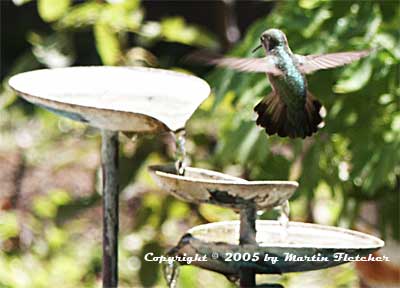
I love to attract hummingbirds to my garden and do so by design. I design my California hummingbird garden using the plants they love. Their activity around the flowers and brilliant colors make the hummingbirds fascinating to watch and great sport to photograph. A California Hummingbird Garden Design is based first around feeding them. Never mind that we think the flowers are beautiful that the hummingbirds find those flowers useful is the important point. Hummingbirds have the basic needs of any hotel guest. Good Hummingbird Food, something to drink and a nice place to sleep and hang out. To these ends I include in a hummingbird garden design a wide variety of plants so something is always in bloom. The hummingbirds like protective cover, and a mixture of trees and shrubs helps. The Hummingbirds most often rest up in an Oak Tree here in my garden and then feed on the flower of the moment and sip from my fountain. A mixture of plants heights is very helpful. The hummingbirds will find a safe place to rest with a good view. And some tinkling water helps attract hummingbirds too. Water motion and sound are a big part in the success of your hummingbird garden design. In the hummingbird photo below, you can see a hummingbird about to get a drink. And a few minutes later the same hummingbird took a bath in one of the small basins with the water running over his back. You can attract hummingbirds to your garden using plants with tubular red flowers or red colored hummingbird feeders. Here is our hummingbird recipe. And our list of plants that will make your hummingbird garden full of life and color. Red dye in the hummingbird food does little to attract the birds, and the dye is harmful to them. Best to use sugar water. And best of all to feed the hummingbirds with the flowers from your garden.
The hummingbirds are the smallest birds in the world. They weigh less than a nickel. Hummingbirds are also the fastest. They have the fewest feathers and the smallest nests, no surprise there. And they have the fastest heartbeats. There are 338 species of hummingbirds and only 23 species have been recorded in the United States. Of those only 16 species have been recorded nesting north of the border with Mexico. That means that most of the hummingbird species live in South and Central America and never make it here.
Hummingbirds are native to the Western Hemisphere. They have coevolved with the plants from this Hemisphere. Their migrations are legendary. Some go from South America to North America. The amount of food required to keep such a small bird warm and moving so fast has to be huge, they often eat their own body weight in nectar every day. You can talk about a dog's life as being pretty relaxing much of the time. Hummingbirds are quite the opposite and have to eat and drink constantly. I put out trickling fountains for attracting hummingbirds. They love falling water and are attracted to the sound of it. They require nectar laden plants. I plant varieties of plants that they already know while they move North and South through the seasons, this makes attracting them much easier because they already know what their food looks like.
In general plants with long tubular orange or red flowers attract hummingbirds. Plants in the honeysuckle and hibiscus families are also great choices to attract hummingbirds. Migrating hummingbirds have already found many of the tropical Salvia's as they went through South and Central America and these plants will grow quite well here in Southern California too. Other non-native plants that work well are the Aloes, Red hot pokers, and other plants in the mint and hibiscus families.
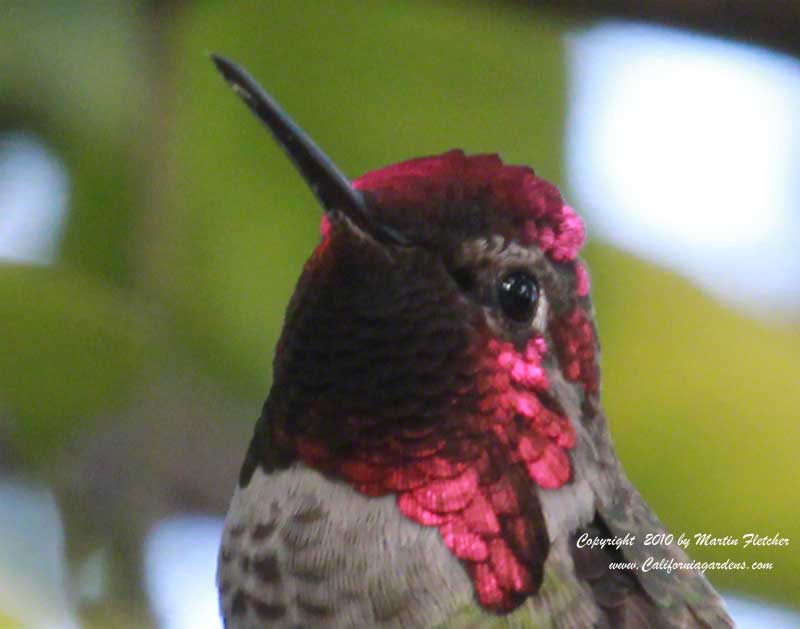
There is recently found fossil evidence that the hummingbirds once lived in Europe too, 35 million years ago. A number of African and Himalayan plants look like they would easily be pollinated by hovering birds. Sunbirds in Africa take that role
I attract a swarm of hummingbirds with our late blooming plants during the fall migration. One the best plants to attract hummingbirds in our garden is Cuphea micropetala, one of the cigar plants. The tubular flowers are orange with yellow tips and sticky with nectar. The plants bloom for us from October until the first hard frost and there is always a hummingbird that is the owner of the bush and 2 or more that think it should be theirs. In warmer gardens I have seen Leonotis leonurus, the Lion's Tail, attract hummingbirds seemingly from the whole neighborhood.
California native plants that provide Winter food for the resident Anna's hummingbirds are the flowers of the Manzanita and Gooseberry species. Salvia spathacea, the hummingbird sage is starts blooming in late January.
I have been intrigued watching a hummingbird work on plants that are not native to our area. The hummingbirds have learned about a number of other plants and feed on them differently. I watched a hummingbird all through lunch one day feeding from a pink Abutilon. Instead of feeding from the inside of the flower it came in from the outside and reached in between the petals. The hummingbird would feed for 2 or 3 minutes and visit about a third of the flowers and then fly off. Then after a short break the hummingbird would return but rarely visit the same flowers. Hummingbirds have an uncanny ability to remember which flowers were visited recently. At first it looks so random, the way the hummingbirds move from flower to flower but as you watch them you can see that they rarely come back to the same blooms before there has been enough time for more nectar to be generated by the flowers. The hummingbirds defend their territory fiercely, chasing off all of their competitors. A hedge of Cape honeysuckle can wear you out doing maintenance on it. But watching the swarm of hummingbirds that will work the length of it is tremendously amusing. One bird cannot possibly defend all of it, though they each try. I have seen similar Herculean hummingbird efforts on large Callistemon viminalis, Bottlebrush trees.