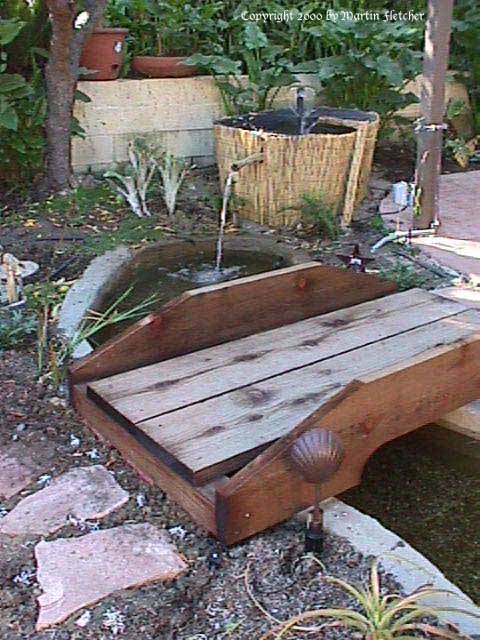
Pond with a Bridge
I thought a few of our ideas on water garden design and pond construction would be helpful in making your water garden a success. We had a planting space between two patios that was filled to eye height with poodle junipers and impatiens. This broke up the visual space. In order to make the area work as a single garden room we had to remove the visual obstacle and replace it with a focal point. We wanted a water feature where we could grow some lilies and have some fish. We also wanted to get from one patio to the other directly. We solved the traffic flow issues with a simple bridge. The space for the pond was relatively small. The client had a large water trough that we wanted to incorporate into the design.
We dug a meandering trench that was a little more than 2 feet deep. I formed a heavy wire mesh into the hole. I poured and plastered concrete 4" thick onto the bottom and sides of my trench. The finished bottom was about 24" deep. Through the sides I laid conduit for electrical wire to the pump and pipe to the float that would control the level of the water as well as a pipe to fill the above ground basin. I sealed the concrete several times with a product called thoroughseal. On the last coat I mixed in a coloring agent so the pond would be a medium shade of brown.
Once I had checked to see that the basin held water I started to incorporate the machinery to make it work. We laid a bed of gravel to increase the pond surface area for filtration. The more surface area that there is the more bacteria will live in the pond. It is the bacteria that do all of the hard work in a pond eating the nutrients that make algae grow. By drawing water through the gravel the effective surface area is multiplied. This allows for even more fish in the pond.
There are two perforated pipes buried in the gravel. These lead to a pump that takes the water up to the upper trough. The umbrella spritzer runs on its own pump. The trough and above ground pipes are wrapped in reed fencing. Planter boxes are set onto the pond bottom to get the full advantage of the maximum depth for the water lily's and to keep the lily roots from invading the gravel. This simple sturdy bridge was set onto a footing of bricks and was made out of rough cut redwood.
The splash of the water obscures much of the noise of the surrounding community. By having more than one kind of splash two things are accomplished. First the upper splash ripples the water of the upper basin so the water pouring out of the lower pipe does not have a constant flow rate. This modulates the sound created by the falling water. Secondly by having two types of splash different sections of the sound spectrum are obscured.
Our water garden right after construction was completed.